Welcome to week two of My Tiny Highlight (MyTH). This week I will focus my attention on a bacterium not many people know about, Azospirillum brasilense or A. brasilense. I know quite a bit about this one since it was the model organism used for my dissertation (sorry, under embargo…no link). The genus Azospirillum is found in almost all soils across the globe. A. brasilense, as you may be able to decipher from its name, was discovered in Brazil and is found associated with roots of different cereals (wheat, corn, even rice). Like most bacteria, A. brasilense is good to have around. It was thought for a long time that this organism provided the plants it colonizes with a usable form of nitrogen since A. brasilense is able to fix nitrogen (turn nitrogen gas found in the atmosphere into useful ammonium). However, A. brasilense is greedy and has two ways to uptake ammonium into the cell if it happens to leak out somehow. So how is A. brasilense beneficial to a plant?
Glad you asked. Azospirilla have the capacity to produce plant hormones, specifically auxins. Auxins are a class of plant hormones derived from the amino acid tryptophan. In plants, among other things, auxins increase nutrient uptake. More nutrients for the plant means increased plant growth and by consequence more nutrients and growth for A. brasilense. So, instead of increasing its own nutrient uptake (which increases the need for energy to be spent), A. brasilense ‘tricks’ the plant into doing it by just producing plant hormones. Brilliant!

Wait…it gets better. Maybe you have heard of quorum sensing (check here). Bacteria produce and release a chemical signal that is recognized by other cells and gives them instructions (go away or come here and settle down). Some recent research (personal observation) suggests auxins are quorum signals in A. brasilense telling other cells to come join in and settle down. Since A. brasilense is almost always motile, moving around in search of the best environment for the cell, a signal telling these cells to stop is amazing.

Picture of A. brasilense colony on agar plant and not color enhanced. They actually are pink/orange from production of carotenoids.

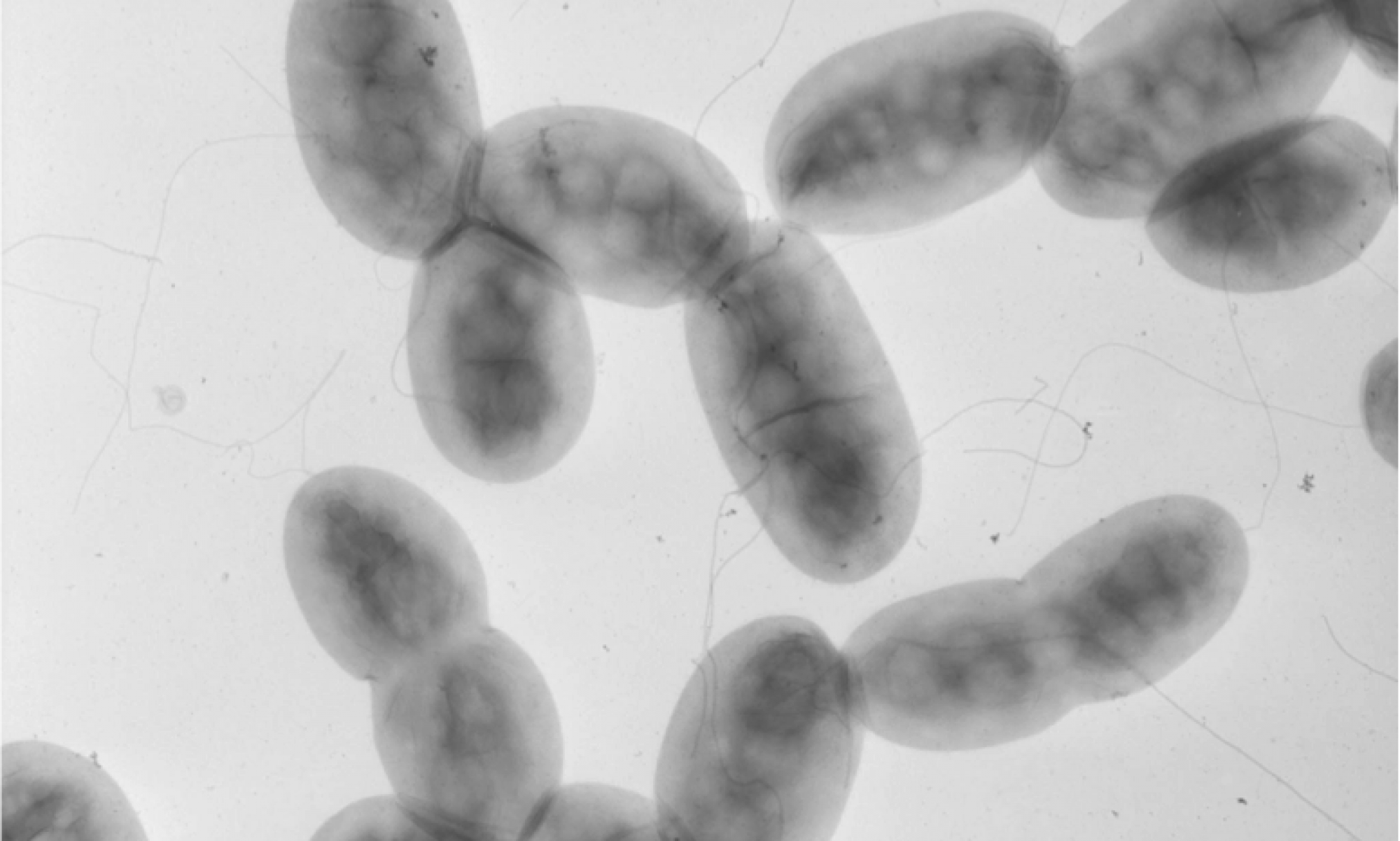
Electron micrograph of A. brasilense.
Watch short movie of A. brasilense swimming in liquid media Here
One amazing behavior in A. brasilense is a phenomenon called aerotaxis. It is similar to chemotaxis, the movement of cells along gradients of a chemical. However, as you might predict, aerotaxis is movement of a cell long a gradient of air. A. brasilense prefer an environment with a low oxygen concentration (~0.4% compared to atmospheric oxygen concentration of 21%). From the meniscus, they will form a thin band of cells at the concentration of oxygen they like in a small capillary filled with liquid (see below).

Image of A. brasilense cells in a small glass capillary. A aerotactic band of cells (whitish in color) forms a certain distance from the meniscus (left side of image).
This is all I can provide at this time. I may update this post at a later time. Hope you enjoy the MyTH series! Next week, I will highlight one of my personal favorites. Stay tuned!
- MyTH: A new weekly series about one bacterial species. First Post: Escherichia coli (mhrussel.wordpress.com)
- Hooray for Failure! It’s Science’s way of telling you you’re not being creative enough (mhrussel.wordpress.com
 Just Science
It’s interesting, but I don’t understand it all. I must try harder. Thanks
It is very hard to wrap your head around. Took me a few years!